Introduction
This was a project I worked on with some colleagues during vocational school. It started as a fairly simple question: how much water could we recover from the air-conditioning system at campus, and could that water be reused instead of just thrown away? We collected data and did some analysis with the idea that one day it might help justify a real recovery system. Since the results could be useful to someone else too, I thought it was worth sharing them.
Initial problem
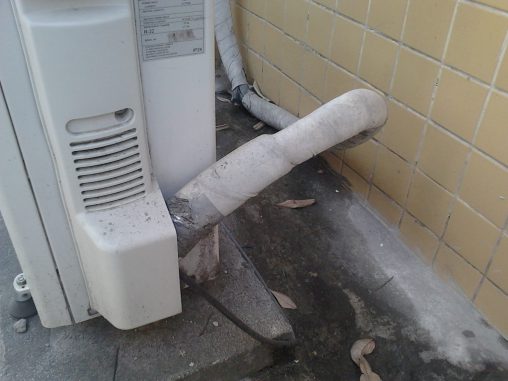
Air conditioners naturally produce water when humid air cools down and the moisture condenses. In most cases, that water is simply drained away and wasted. At the campus where I studied, the drainage system was not very well organized, so the runoff from the units spread across the floor and ended up damaging the nearby structures.
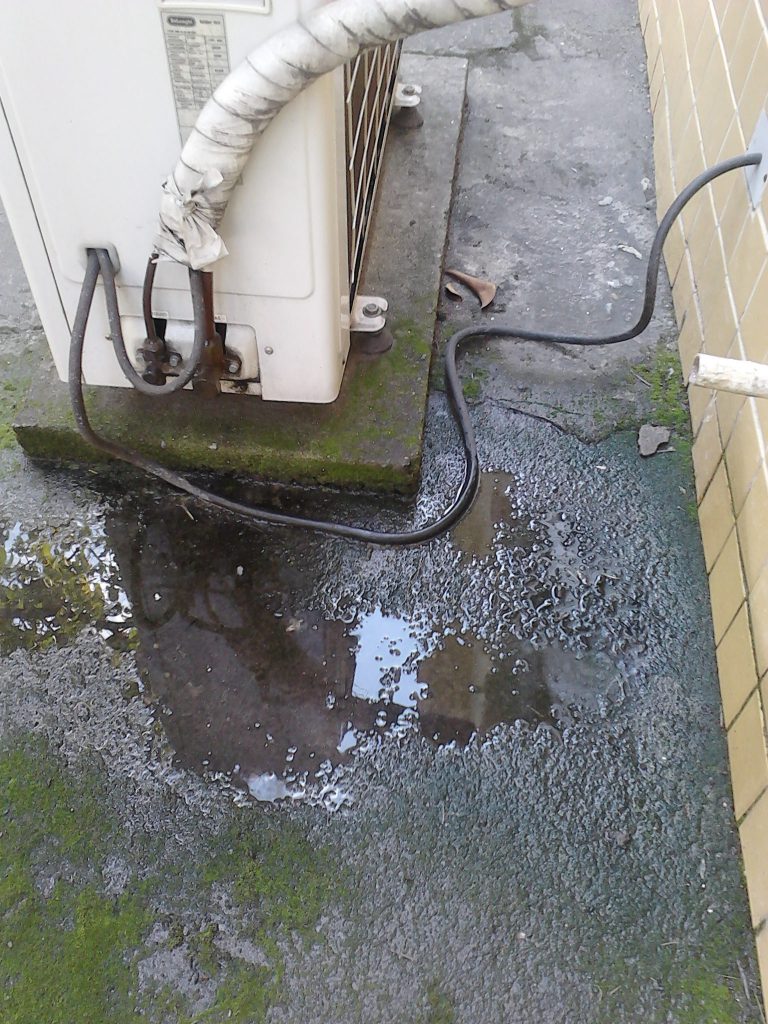
Problems caused by the water
Measurement process
To measure the amount of water, we built a few simple measuring bottles. They were made from plastic soda bottles with volume markings visible on the side. To make the measurements reliable, we followed the DOQ-CGRE-027 standard from Inmetro, which is the Brazilian metrology authority for level measurement. We weighed the bottles on a semi-analytical scale, slowly filled them with distilled water using a pipette, and used the known density of the water to infer the volume. Once we knew the volume, we marked the bottles carefully with a height gauge and built our own scale step by step.
When the bottles were ready, we placed them under the drain tube and collected water at regular intervals. We also recorded temperature and relative humidity during the process with a thermohygrometer so the results would be easier to interpret.
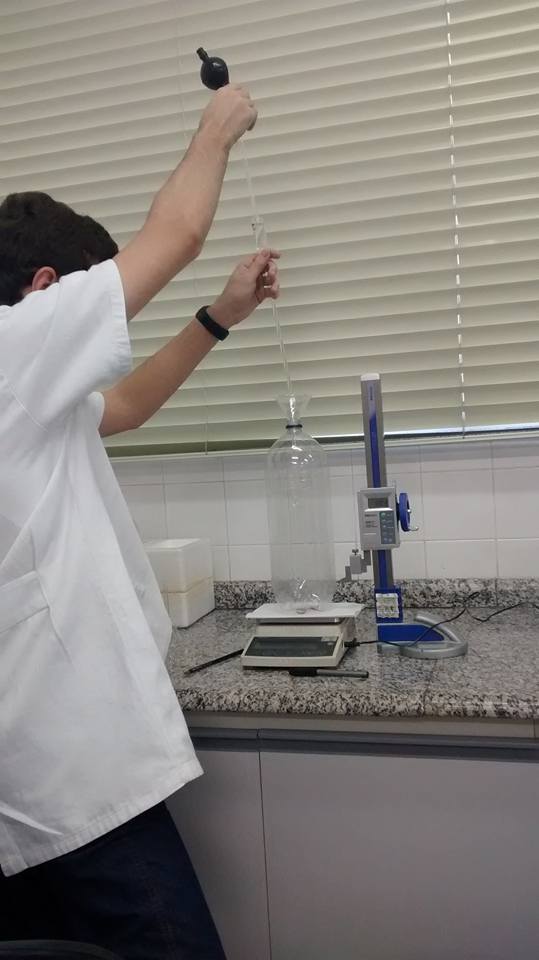
Building process
Results
We did three sets of measurements, about a month apart. They were made in an air conditioner of the Springer brand with a potency of 36000 BTU/h
Measurements (27/08/15)
| (27/08/15) | Time between measurements | Initial Relative humidity | Initial Temperature (°C) | Volume of water (mL) | Final Temperature (ºC) |
|---|---|---|---|---|---|
| 1 | 15 min | 66% | 23,9 | 500 | 24,9 |
| 2 | 15 min | 62% | 24,9 | 500 | 25,6 |
| 3 | 15 min | 59% | 25,6 | 500 | 26,0 |
| 4 | 15 min | 58% | 26,0 | 650 | 26,2 |
Measurements (27/07/15)
| (27/07/15) | Time between measurements | Initial Relative humidity | Initial Temperature (°C) | Volume of water (mL) | Final Temperature (ºC) |
|---|---|---|---|---|---|
| 1 | 15 min | 48% | 28 | 350 | 27,8 |
| 2 | 15 min | 45% | 27,8 | 275 | 26,8 |
| 3 | 15 min | 46% | 26,8 | 350 | 25,8 |
| 4 | 15 min | 52% | 25,8 | 350 | 25,3 |
Measurements (18/06/15)
| (18/06/15) | Time between measurements | Initial Relative humidity | Initial Temperature (°C) | Volume of water (mL) | Final Temperature (ºC) |
|---|---|---|---|---|---|
| 1 | 15 min | 41% | 31,8 | 300 | 31,8 |
| 2 | 15 min | 41% | 31,8 | 300 | 31 |
| 3 | 15 min | 36% | 31 | 300 | 30,7 |
| 4 | 15 min | 42% | 30 | 300 | 30,1 |
| 5 | 15 min | 38% | 30,1 | 300 | 30,5 |
| 6 | 15 min | 38% | 30,5 | 300 | 30,4 |
The amount of water condensed by the air-conditioning unit was much larger than we expected, which made the project feel a lot more relevant. Beyond the measurements themselves, the work also helped us develop a method that could support the case for implementing water-reuse systems in similar buildings and contribute to the conservation of natural resources.
Comments
Comment with your GitHub account.